
Botox and anti-wrinkle injections
Botox is a brand name for botulinum toxin, a purified protein that relaxes chosen facial muscles for a few months. It softens lines that form when you frown, squint or raise your brows. It is a prescription treatment that must be given by a doctor.
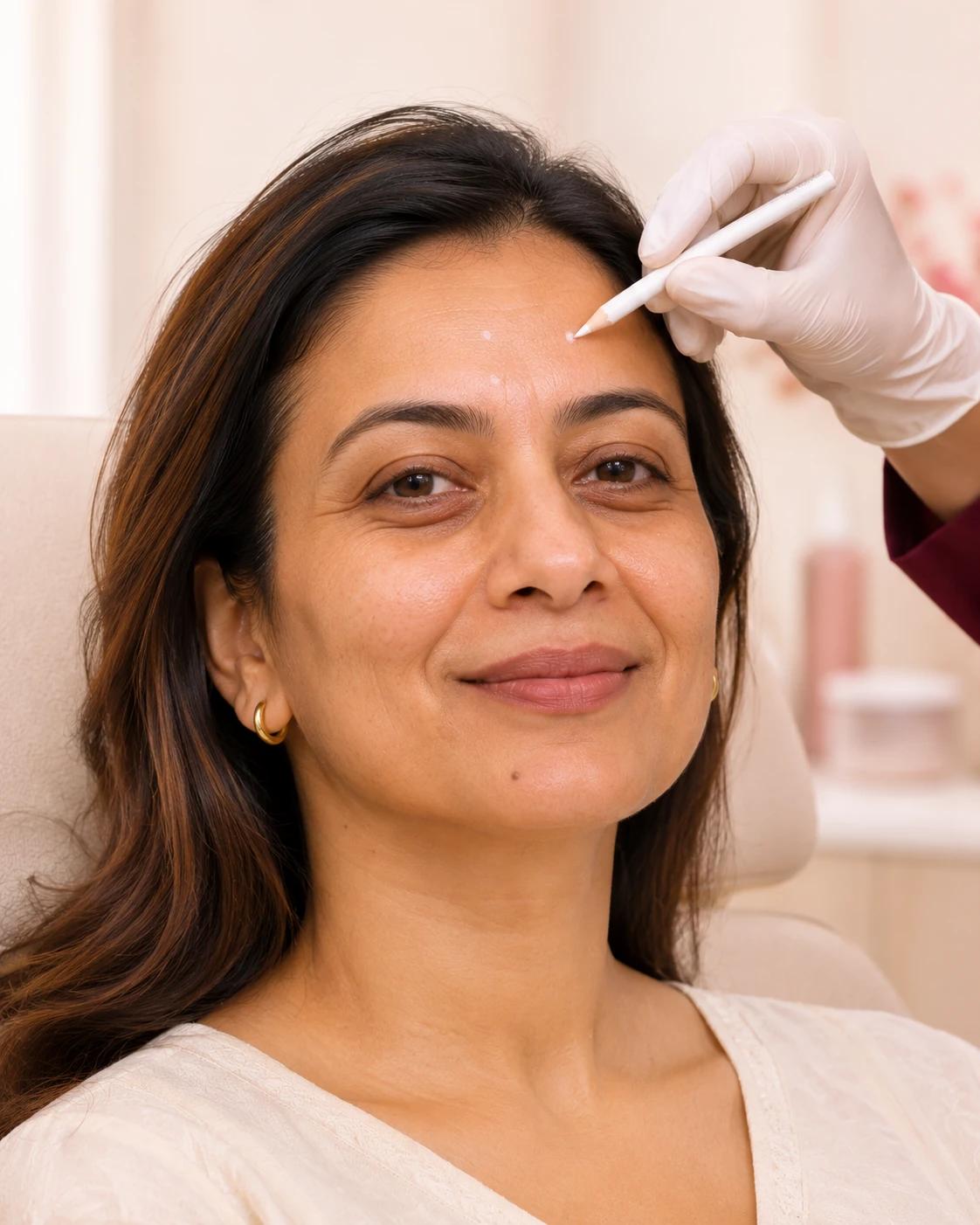
Illustrative model. Not a patient.
- First step
- Consultation and face check
- Time
- About 10 to 15 minutes
- Downtime
- Usually none
- Lasts
- About 3 to 4 months
What it is
Repeated muscle movement creases the skin above it. Over the years, these creases become lines that stay even when the face is at rest.
Tiny amounts of botulinum toxin are injected into the muscles that create these lines. The muscle activity reduces, so the skin above smooths out. Nearby muscles keep working, so you can still smile and show expression. Botox is one brand; other approved botulinum toxin brands work in a similar way.
Who it may suit
- Forehead lines: horizontal lines when you raise your brows
- Frown lines ("11 lines"): vertical lines between the brows
- Crow's feet: fan-shaped lines at the outer eye corners
- Early treatment: for people whose lines are just starting to stay at rest
- Other selected uses after assessment: a square jaw from strong chewing muscles, a gummy smile, a dimpled chin, neck bands or heavy underarm sweating
Botox treats lines caused by movement. Lines and folds caused by volume loss or sagging are better treated with dermal fillers, a thread lift or a face lift.
It is not suitable during pregnancy or breastfeeding, with some nerve or muscle diseases such as myasthenia gravis, with an infection at the injection site, or after an allergy to botulinum toxin.
How Dr. Saloni assesses it
- Watches how your face moves when you frown, smile and raise your brows.
- Checks brow position and eyelid heaviness, because these affect where it is safe to inject.
- Asks about past injections, medicines and medical conditions.
- Agrees a dose and plan that keeps natural expression. The aim is a rested look, not a frozen one.
Options
 Upper face
- What it involves: Forehead lines, frown lines and crow's feet.
- Usual downtime: Small marks at injection points for a short while.
Lower face and neck
- What it involves: Jaw slimming, gummy smile, dimpled chin or neck bands, after assessment.
- Usual downtime: Mild tenderness.
Review visit
- What it involves: A short check at about 2 weeks to fine-tune balance.
- Usual downtime: None.
What happens on the day
- Make-up is removed and the skin cleaned.
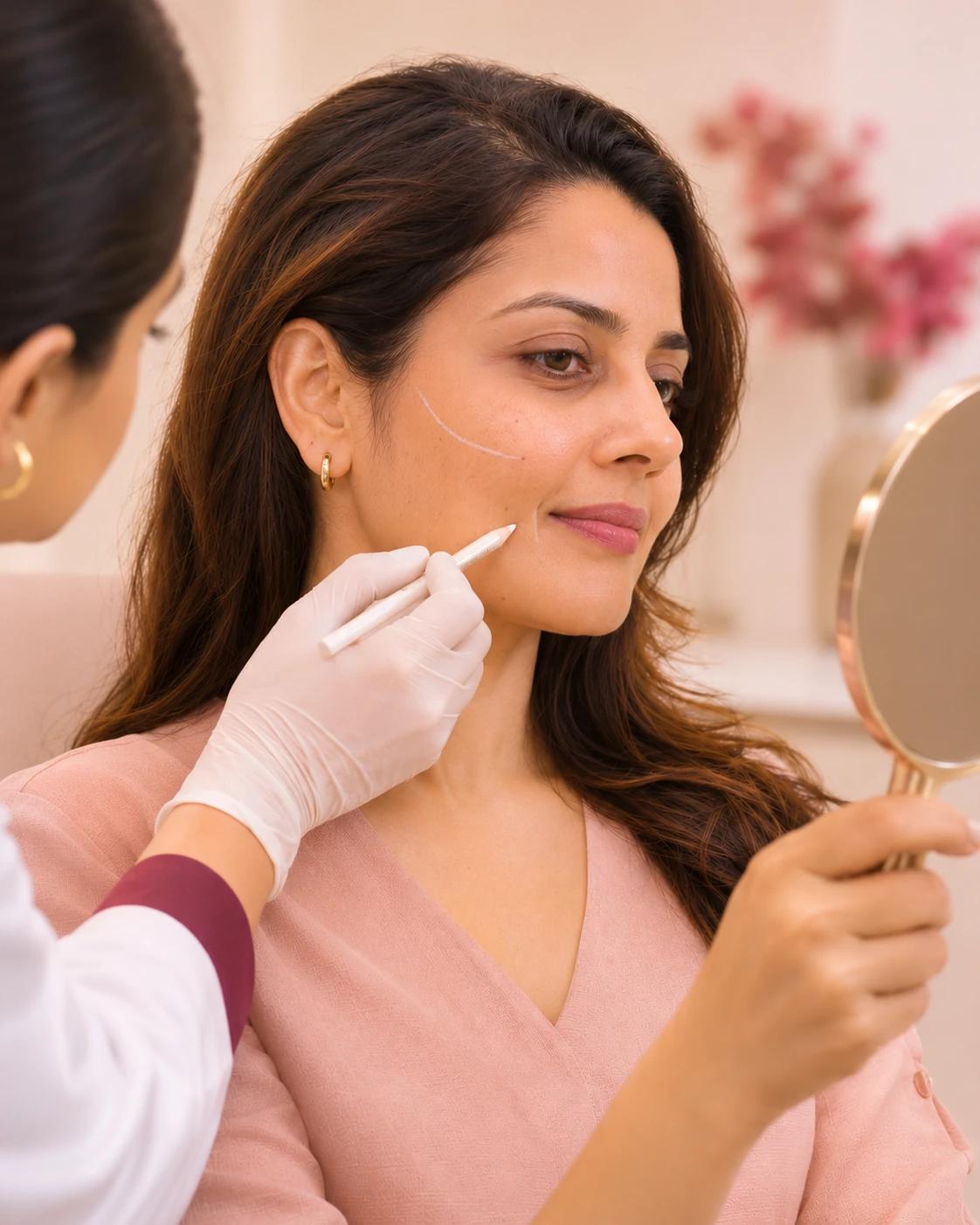
- Injection points are marked.
- A few small injections are given with a very fine needle. This takes about 10 to 15 minutes.
- You can return to work or normal activities straight away.
When it works and how long it lasts
| Time | What to expect |
|---|---|
| Days 3 to 5 | The effect starts to show. |
| Day 14 | Full effect, and a review visit if needed. |
| Months 3 to 4 | Movement slowly returns and lines gradually come back. |
Most people repeat treatment every 3 to 6 months.
Aftercare
- Stay upright for 4 hours. Do not lie flat or bend down for long.
- Do not rub or massage the treated area for 24 hours.
- Avoid heavy exercise, saunas and alcohol for 24 hours.
- Make-up can usually be applied after a few hours.
Risks and limits
Risks include small red bumps, bruising or tenderness at injection points; headache for a day or two; drooping of an eyelid or brow, which is temporary; an uneven or surprised look, which can be adjusted at review; and rare allergic reactions.
Results differ from person to person and cannot be guaranteed.
Seek urgent medical help if, after any injection, you have difficulty swallowing, speaking or breathing, double vision, or new weakness away from the treated area.
Questions
Will my face look frozen?
No, not with a tailored dose. The aim is softer lines with natural movement.
How long does Botox last?
Usually 3 to 4 months, sometimes a little longer.
When does Botox start working?
The effect starts in 3 to 5 days and is complete at about 2 weeks.
Does it hurt?
Most people feel a brief sting with each injection. Ice or numbing cream can be used.
What happens if I stop?
Muscles gradually return to normal and lines return to how they would have been. Stopping does not make lines worse.
Botox or fillers?
Botox relaxes muscles to soften lines caused by movement. Fillers restore lost volume. Many people benefit from both.
Is Botox safe?
It has been used in medicine for decades. It is safe when given by a trained doctor using an approved product and the right dose.
What happens after my consultation?
I examine you first. The team then explains the recommended treatment, how many sessions it needs, and the packages and fees, so you can decide in your own time. Nothing is started on the same visit unless you are ready.
Please do not share medical details in the booking form.
MBBS, MS (ENT), Fellowship in Rhinoplasty, Fellowship in Facial Aesthetic Surgery. Delhi Medical Council reg. no. 57646. Last reviewed November 2026.
This page is for general information and does not replace a consultation. Results vary between people.
Related treatments.
In-depth answers.
Forehead Lines and Crow's Feet: How Can They Be Reduced Without Surgery?
How forehead lines, frown lines and crow's feet can be softened without surgery, using anti-wrinkle injections and skin treatments. What to expect and the risks.
Anti-Wrinkle Injections vs Dermal Fillers: What Is the Difference?
Anti-wrinkle injections relax muscles. Fillers restore volume. How they differ, which concern each treats, how long they last, and the safety points.
Early Signs of Ageing: Which Non-Surgical Treatment Should You Start With?
Noticing fine lines, dullness or volume loss in your late 20s to 40s? Which non-surgical treatments to discuss first, and what a good anti-ageing plan looks like.
Start with a conversation.
One consultation with me. I look, explain, and you decide in your own time.