
Mole changes.
Growth, new colours, irregular edges or bleeding need review.
Most moles, tags and warts are harmless, but any change should be checked by a doctor before anything is removed.
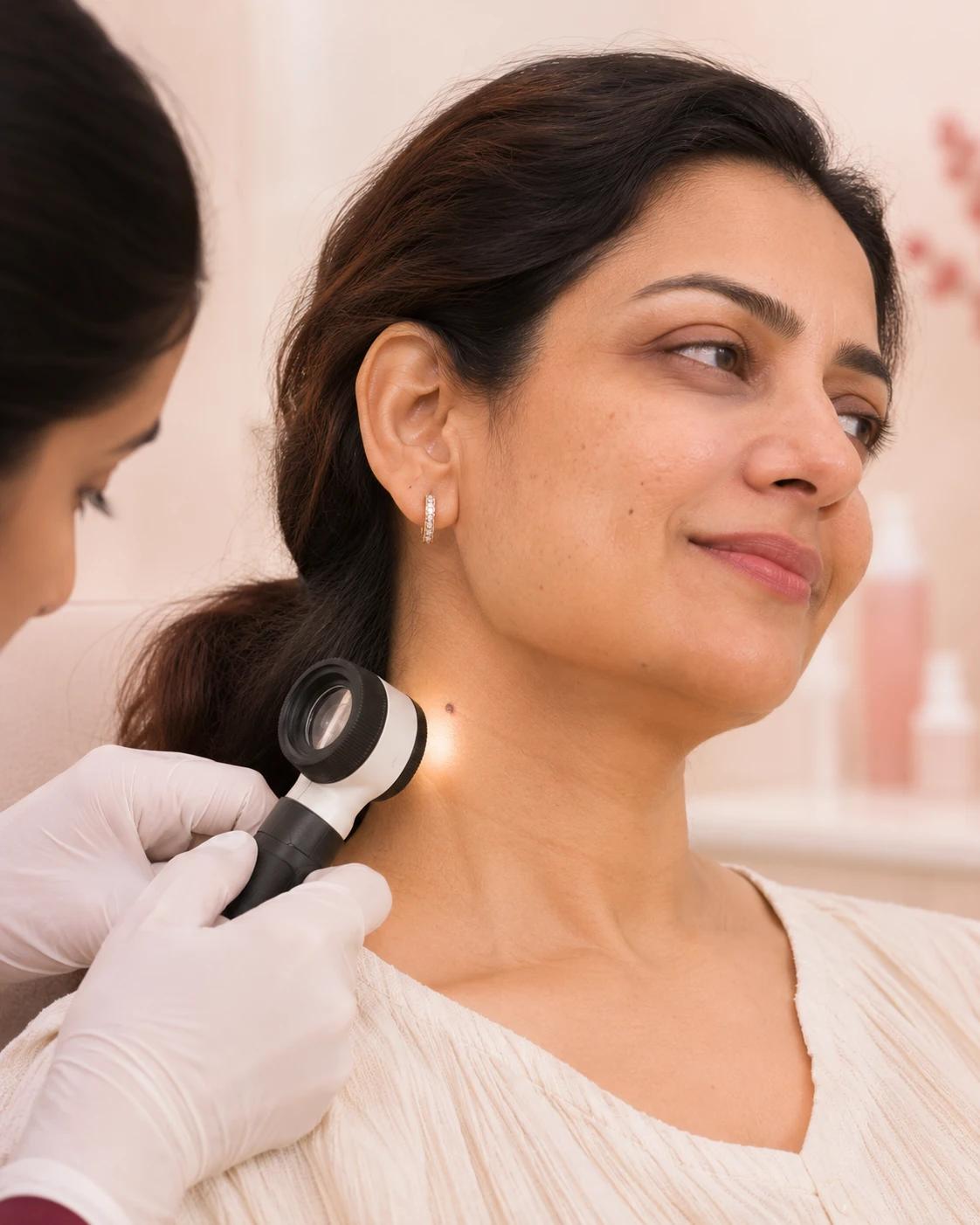
Illustrative model. Not a patient.
Moles are clusters of pigment cells. Skin tags are soft folds of skin. Warts come from a virus. Each needs a different approach, and some growths should be sent for lab testing.
Growth, new colours, irregular edges or bleeding need review.

Tags often appear where skin rubs, such as the neck or underarms.

Warts spread by contact and can come back.

Some people choose removal for comfort or appearance.
The doctor examines the growth with a dermatoscope. Any growth that looks unusual is removed fully and sent for lab testing, not just treated cosmetically.
 Dermatoscope check
 Minor removal
 Lab testing
Number of sessions, intervals and suitability are decided by the doctor after assessment.
See a doctor if a mole shows any of these: Asymmetry (one half unlike the other), Border that is ragged or blurred, Colour with several shades or very dark, Diameter larger than about 6 mm, or Evolving (changing in size, shape or colour, itching or bleeding).
| Method | Used for |
|---|---|
| Radiofrequency or cautery | Skin tags, small raised moles, some warts |
| Shave or snip removal | Skin tags, raised moles |
| Surgical excision with stitches | Moles that need lab testing, deeper moles |
Keep the area clean and dry, and apply the ointment advised until it heals, usually in 5 to 10 days. Protect healed skin from the sun to lower the risk of a dark mark.
Scarring, infection, pigment change and recurrence are possible. Never attempt to cut or burn growths at home.
Results differ from person to person and cannot be guaranteed.
See a doctor soon for a mole that changes, bleeds, itches, or looks different from others. Do not wait.
No. Most are harmless. A check tells you which need attention.
Warts can. Moles and tags usually do not, but new ones can appear.
When the doctor advises it, yes. Ask at the visit.
A small flat or pale mark may remain. Most fade over months.
Many skin tags can be a sign of insulin resistance. The doctor may suggest a blood sugar check.
Yes, they spread by contact. Do not share towels or razors, and avoid picking.
Please do not share medical details in the booking form.
MBBS, MS (ENT), Fellowship in Rhinoplasty, Fellowship in Facial Aesthetic Surgery. Delhi Medical Council reg. no. 57646. Last reviewed November 2026.
This page is for general information and does not replace a consultation. Results vary between people.
What causes warts, why they spread and come back, how they are removed on the face, neck and fingers, and whether moles, tags and warts can be treated together.
Why every mole should be examined before removal, warning signs to watch (ABCDE), removal methods, when a sample is sent to the lab, and scarring.
Why skin tags multiply on the neck and underarms, the link with weight and blood sugar, how a doctor removes them safely, and why not to cut them at home.
One consultation with me. I look, explain, and you decide in your own time.
We use a few cookies to understand how the site is used. Nothing starts until you choose. Read the privacy policy.