
Fat grafting (facial fat transfer)
Fat grafting moves a small amount of your own fat to areas of the face that have lost volume. Because it is your own tissue, the fat that survives is usually long lasting.
- First step
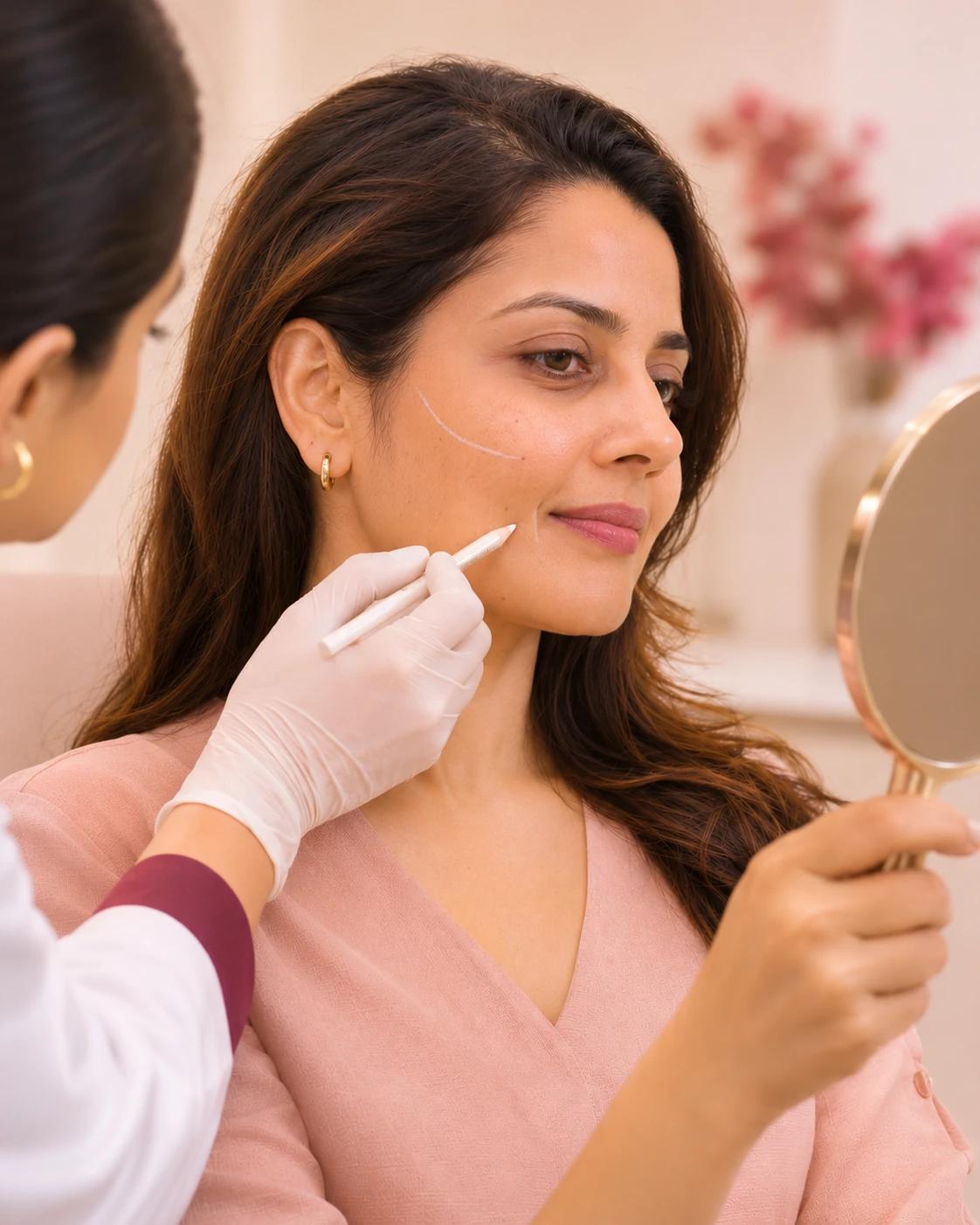
- Consultation and face check
- Anaesthesia
- General or local
- Hospital stay
- Usually one day
- Swelling
- About 1 to 2 weeks
What it is
Fat is gently taken with a thin tube (liposuction) from the tummy or thighs. It is cleaned and then placed in tiny amounts into the face with a fine cannula. Fat also contains cells that can improve skin quality.
Who it may suit
- Hollow cheeks or temples
- Under-eye hollows
- Deep folds from the nose to the mouth
- Thin lips
- Depressed scars, including some acne scars
- Adding volume during a face lift
How Dr. Saloni assesses it
- Looks at where volume has been lost and how it changes your face.
- Checks a suitable donor area.
- Explains what one session can achieve and whether a second may be needed.
Options
Facial fat grafting
- What it involves: Fat placed in the cheeks, temples, under-eyes or lips.
- Recovery: Swelling for 1 to 2 weeks.
Fat grafting with a face lift
- What it involves: Volume restored during lifting surgery for a balanced result.
- Recovery: As for a face lift.
Fat grafting for scars
- What it involves: Fat placed under depressed scars to lift and soften them.
- Recovery: Swelling for about 1 week.
Where and how it is done
Surgery is done under general or local anaesthesia, depending on the procedure and what suits you. Most patients stay for one day. I perform the surgery myself, and details of the operating facility are given at consultation. Fat grafting takes about 1 to 2 hours.
Recovery
The face is swollen for 1 to 2 weeks, and the donor area is bruised and sore for a similar time. Some of the fat is absorbed over the first 3 months. The result that remains after this is usually long lasting.
Risks and limits
Risks include swelling, bruising, lumps or uneven contour, absorption of more fat than expected, infection, and, rarely, fat entering a blood vessel. A second session is sometimes needed.
Results differ from person to person and cannot be guaranteed.
Contact the clinic straight away for severe pain, skin colour changes, fever, or any change in vision.
Questions
How long does fat grafting last?
Fat that survives after the first few months is usually long lasting, because it becomes living tissue.
Will all the fat stay?
No. Some fat is absorbed in the first few months, so a little extra is placed and a second session is sometimes needed.
Fat grafting or fillers?
Fillers are quicker with less downtime but are temporary. Fat is your own tissue and longer lasting, but needs a small surgical procedure.
Where is the fat taken from?
Usually the tummy or thighs, through tiny cuts.
What happens after my consultation?
I examine you first. The team then explains the recommended treatment, how many sessions it needs, and the packages and fees, so you can decide in your own time. Nothing is started on the same visit unless you are ready.
Please do not share medical details in the booking form.
MBBS, MS (ENT), Fellowship in Rhinoplasty, Fellowship in Facial Aesthetic Surgery. Delhi Medical Council reg. no. 57646. Last reviewed November 2026.
This page is for general information and does not replace a consultation. Results vary between people.
Related treatments.
Start with a conversation.
One consultation with me. I look, explain, and you decide in your own time.