
Scar revision
Scar revision improves the look of a scar so that it is flatter, thinner, closer to skin colour and less noticeable. The method depends on the type, size and position of the scar.
- First step
- Consultation and scar check
- Anaesthesia
- Usually local
- Sessions
- Depends on the method
- Important
- Scars improve, not vanish
What it is
Scars form as part of normal healing after injury, surgery, burns or acne. Some heal as fine lines; others become wide, raised, sunken, tight or discoloured. Scar revision uses one or more methods to improve them.
Who it may suit
- Wide or stretched scars after surgery or injury
- Raised (hypertrophic) scars or keloids
- Sunken scars, including some acne scars
- Scars that pull or limit movement, such as some burn scars
- Scars that sit against the natural skin lines of the face
How Dr. Saloni assesses it
- Asks how and when the scar formed, and whether you form raised scars easily.
- Examines its width, height, colour and direction.
- Explains which methods, alone or combined, are likely to help most.
Options
Surgical revision
- What it involves: The scar is cut out and closed carefully in layers, sometimes changing its direction (Z-plasty or W-plasty) to follow natural skin lines.
- Usual downtime: Stitches for about 1 week.
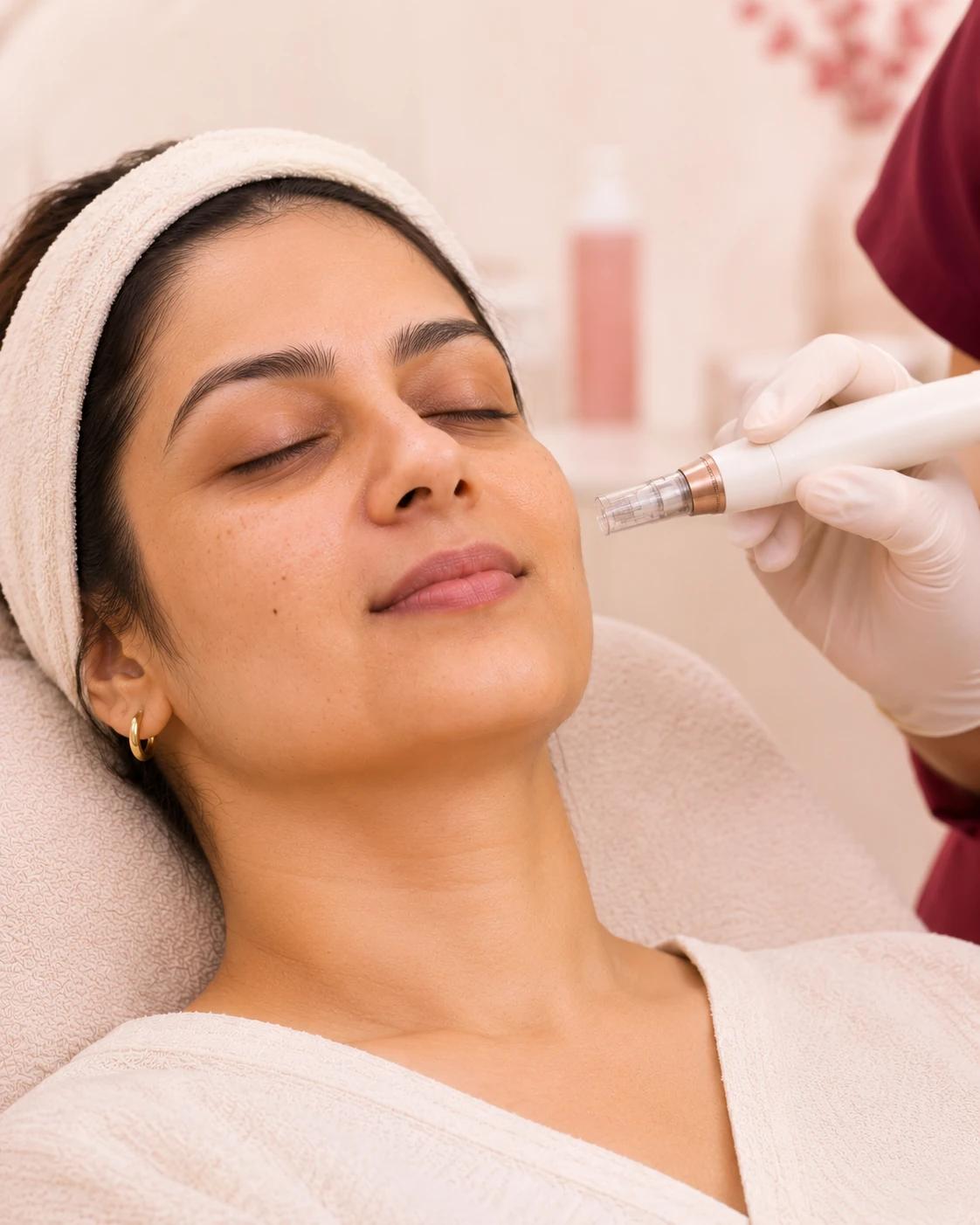
Laser and MNRF
- What it involves: To smooth texture and blend colour, often after surgical revision. See microneedling and MNRF.
- Usual downtime: A few days of redness.
Injections and silicone
- What it involves: Steroid injections and silicone gel or sheets to flatten raised scars and keloids.
- Usual downtime: Little or none.
Fat grafting
- What it involves: Your own fat placed under sunken scars. See fat grafting.
- Usual downtime: Swelling for about 1 week.
Where and how it is done
Most scar revisions are done under local anaesthesia. Larger revisions may be done under general anaesthesia.
Recovery
After surgical revision, stitches are removed at about 5 to 10 days. The new scar is pink at first and improves over 6 to 12 months. Sun protection and silicone gel help it settle.
Risks and limits
Risks include infection, a scar that widens or rises again, pigment change, and keloid return in people prone to them.
Results differ from person to person and cannot be guaranteed.
Contact the clinic for increasing pain, redness, swelling, discharge or fever after a procedure.
Questions
Can a scar be removed completely?
No. Scar revision aims to make a scar flatter, thinner and less noticeable. It cannot remove it fully.
When can a scar be revised?
Usually once it has matured, about 12 months after the injury or surgery. Raised scars may be treated earlier with injections.
Can keloids be treated?
Yes, but they can come back, so a combined plan with injections and close follow-up is used.
How many sessions are needed?
Surgical revision is usually one procedure. Laser, MNRF or injections usually need a series.
What happens after my consultation?
I examine you first. The team then explains the recommended treatment, how many sessions it needs, and the packages and fees, so you can decide in your own time. Nothing is started on the same visit unless you are ready.
Please do not share medical details in the booking form.
MBBS, MS (ENT), Fellowship in Rhinoplasty, Fellowship in Facial Aesthetic Surgery. Delhi Medical Council reg. no. 57646. Last reviewed November 2026.
This page is for general information and does not replace a consultation. Results vary between people.
Related treatments.

Start with a conversation.
One consultation with me. I look, explain, and you decide in your own time.