
Laser hair reduction
Laser hair reduction, often called laser hair removal, uses light to weaken hair follicles so that less hair grows back. It gives long-lasting reduction over a course of sessions. It does not promise every hair will go for good.
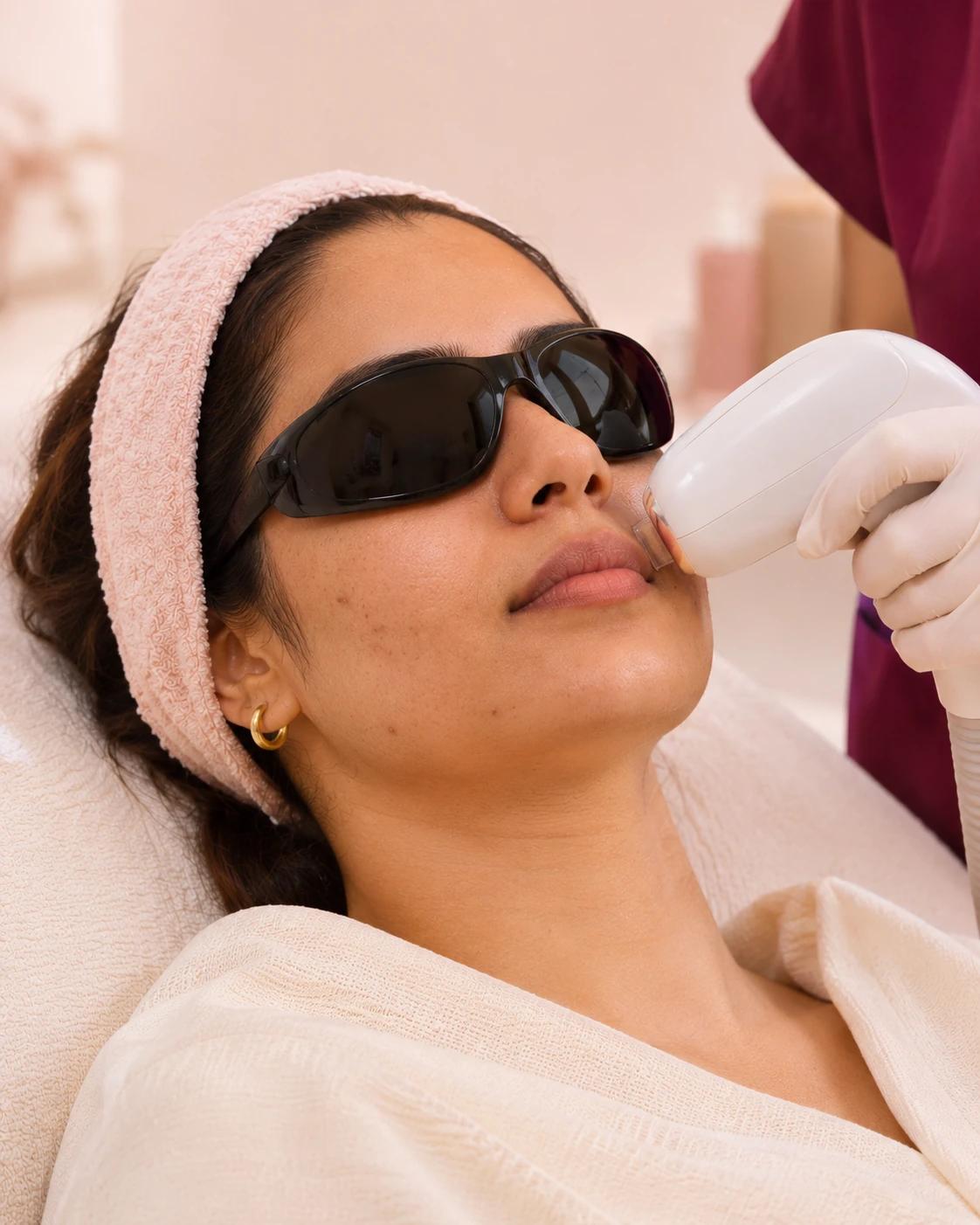
Illustrative model. Not a patient.
- First step
- Consultation and test patch
- Sessions
- Usually 6 to 10
- Gap
- 4 to 8 weeks
- Downtime
- Redness for a few hours
What it is
The laser sends light into the skin. The dark pigment (melanin) in the hair absorbs it and turns it into heat, which damages the follicle and slows regrowth. The surrounding skin is protected with cooling and settings matched to your skin tone.
Hair grows in cycles, and the laser works best on hairs in the active growth phase. Only some hairs are in that phase at any time, so a series of sessions is needed to reach them all.
Reduction or removal: what to expect
"Laser hair removal" is the common name, but "reduction" is the accurate one. Most people see fewer, finer and lighter hairs, and smoother skin for months at a time. Some hair can return over the years, especially with hormonal changes, so a maintenance session once or twice a year may be needed.
Who it may suit
- Dark, coarse hair: responds best, because the laser targets pigment.
- Indian skin tones: suitable with the right laser and settings. A test patch is done first.
- Women with unwanted facial hair: on the upper lip, chin, jawline or neck, including hair linked to PCOS.
- Men: for beard shaping, neck, back, chest and shoulders.
- Ingrown hairs and razor bumps: laser often helps people who get painful bumps after shaving or waxing.
- People tired of waxing and threading: who want a longer-lasting option.
Laser works poorly on white, grey, red or very fine blonde hair, because these hairs have little pigment.
Areas treated
| Area | Notes |
|---|---|
| Upper lip, chin, sideburns, full face | Small areas, quick sessions, careful settings around the eyes |
| Neck and jawline | Common with hormonal hair growth |
| Underarms | Quick, and helps with darkening from shaving |
| Arms and hands | Larger area, done in a series |
| Legs (half or full) | Larger area, longer gaps between sessions |
| Bikini line and Brazilian | Done with privacy and extra care for sensitive skin |
| Back, chest, shoulders | Common for men |
| Full body | Planned across sessions |
The laser and your skin
Aishanya uses a medical-grade laser, with settings chosen for your skin tone and hair type at every session.
Laser or IPL? IPL (intense pulsed light) is a broad light, not a true laser, and is often used in salons. A medical laser targets the hair more precisely and is generally safer and more predictable on darker skin.
How the doctor assesses it
- Checks your hair colour, thickness and skin type.
- Asks about recent tanning, medicines that increase light sensitivity, and any history of keloids or cold sores.
- Looks for signs of a hormonal cause, such as irregular periods, acne or hair on the chest and abdomen, and suggests tests if needed.
- Does a small test patch before the first full session.
What a course looks like
| Area | Usual sessions | Gap between sessions |
|---|---|---|
| Face | 6 to 10 | 4 to 6 weeks |
| Underarms | 6 to 8 | 4 to 6 weeks |
| Arms and legs | 6 to 8 | 6 to 8 weeks |
| Bikini and body | 6 to 8 | 6 to 8 weeks |
Most people notice less hair after 2 to 3 sessions. Maintenance sessions once or twice a year may be needed.
On the day
- The area is shaved, cleaned and marked.
- You and the doctor wear eye protection.
- The laser is passed over the skin with cooling. Small areas take 10 to 15 minutes; legs or back take longer.
- A soothing gel is applied and you can go back to normal activities the same day.
Most people describe the feeling as a quick snap, like a rubber band, or a warm prick. Cooling makes it comfortable.
Before and after a session
Before: shave the area 24 hours before. Do not wax, thread or pluck for 4 to 6 weeks, because the laser needs the root in place. Avoid sun tanning and tanning creams for 2 weeks.
After: use a soothing gel and sunscreen. Avoid hot showers, saunas, the gym and swimming for 24 hours. Shaved hairs may appear to grow and then shed over 1 to 3 weeks; this is normal.
Laser or waxing, threading and creams
| Laser hair reduction | Waxing or threading | Hair removal creams | |
|---|---|---|---|
| How long it lasts | Months, often longer, after a course | 2 to 4 weeks | A few days |
| Ingrown hairs | Usually fewer | Common | Less common |
| Skin darkening | Often improves | Can worsen with repeated waxing | Can irritate |
| Done by | Doctor-led clinic | Salon | At home |
Laser and hormones
Excess facial hair in women can be linked to PCOS or other hormonal conditions. Laser reduces the hair, but if the hormonal cause is untreated, new hair can keep growing. I look for these signs and may suggest blood tests or a referral alongside laser.
After your consultation
Every treatment at Aishanya starts with a consultation with Dr. Saloni. After examining your skin and understanding your goals, she and the team explain the recommended treatment, the number of sessions, and the packages and fees, so you can decide in your own time.
Risks and limits
Risks include redness and swelling for a few hours, small bumps around the follicles, blistering or burns, darkening or lightening of the skin, and, rarely, increased hair growth near the treated area. These are more likely on tanned skin, so sun protection matters. Eye protection is worn at all times.
Results differ from person to person and cannot be guaranteed.
Contact the clinic if you notice blisters, severe pain, crusting, or a change in skin colour after a session.
Questions
Is laser hair removal permanent?
It gives long-lasting reduction rather than guaranteed permanent removal. Most people see far fewer, finer hairs after a full course. Some hair can return over the years, especially with hormonal changes, so one or two maintenance sessions a year may be needed.
How many sessions will I need?
Most areas need 6 to 10 sessions, spaced 4 to 8 weeks apart. Coarse hair on the face or hair linked to hormones can need more. I set the plan after the first assessment and adjust it as you respond.
Is laser hair removal safe for Indian skin?
Yes, when the right type of laser and settings are used. Darker skin holds more pigment, so careful settings and a test patch lower the risk of burns or pigment change.
Does laser hair removal hurt?
Most people feel a quick snap or a warm prick with each pulse. Cooling makes it comfortable, and sensitive areas such as the upper lip or bikini line can feel sharper. Numbing cream is rarely needed.
Can I do laser on my upper lip and chin?
Yes. These are among the most common areas treated in women. If the hair is coarse or keep growing back, I may check for a hormonal cause such as PCOS.
Does laser work for men?
Yes. Men often treat the back, chest, shoulders and neck, or use laser for beard shaping and razor bumps. Male hair is often denser, so more sessions may be needed.
Can I shave between sessions?
Yes, shaving is the only hair removal advised between sessions. Waxing, threading and plucking remove the root that the laser needs, so they are avoided for the whole course.
Is laser better than IPL?
A medical laser targets hair more precisely than IPL, which uses a broad light. For darker Indian skin, a laser is generally more predictable and safer.
Can I have laser during pregnancy?
It is usually postponed during pregnancy and breastfeeding as a precaution. Hair growth can also change during pregnancy and settle afterwards.
When will I see results?
Many people see less hair after 2 to 3 sessions. The full result is seen after the course is complete.
What happens after my consultation?
I examine you first. The team then explains the recommended treatment, how many sessions it needs, and the packages and fees, so you can decide in your own time. Nothing is started on the same visit unless you are ready.
Laser hair reduction, explained
A short educational video from the clinic's YouTube channel. It loads only when you press play.
Please do not share medical details in the booking form.
MBBS, MS (ENT), Fellowship in Rhinoplasty, Fellowship in Facial Aesthetic Surgery. Delhi Medical Council reg. no. 57646. Last reviewed November 2026.
This page is for general information and does not replace a consultation. Results vary between people.
Related treatments.

In-depth answers.
Unwanted Facial Hair in Women: When Is It Hormonal, and Can Laser Help?
Upper lip, chin or jawline hair in women can be hormonal. When to check for PCOS, how laser hair reduction helps, and what to expect from treatment.
How Many Laser Hair Reduction Sessions Will I Need?
Most people need 6 to 8 or more laser hair reduction sessions. Why multiple sessions are needed, spacing by body area, and what affects your number.
Is Laser Hair Reduction Safe for Indian Skin?
Laser hair reduction can be safe for Indian skin with the right laser, settings and test patch. How it works, which lasers suit brown skin, risks and results.
Start with a conversation.
One consultation with me. I look, explain, and you decide in your own time.